learning nerd | studious recluse | intermediate-advanced
As language learners we are constantly told to start with kids books. We are told that if we don’t understand enough of what we are reading it will become demoralising. But often we are already demoralised by constantly having our language level confused with our intellect. Annotated Novels, closely linked to “Memrise a Nice Novel”, resolutely rejects this perceived wisdom, saying, ‘no, fuck it, I will struggle through this novel three times to get the pay-off!’
Annotated Novels are attempts to read literature far beyond our language level, documenting the struggle along side the narrative, with underlines words and highlighted phrases. While it demands a lot of work, the reward comes in the moments when one comprehends complex sentences which convey deep cultural information.
The following is an insight into how Ahilan likes to annotate novels, but use it as inspiration to come up with your own system rather than a strict method.
=============
A GUIDE TO ANNOTATING A NOVEL FOR LANGUAGE LEARNING
CHOICE OF BOOK
+ It can be nice to dream big with this one and thus choose a novel which somehow encapsulates the language and culture you wish to learn.
+ While the most tempting choice is often a novel, a bundle of short stories can work really well with this as it contains the task making it a little bit less daunting.
TOOLS
Use Expertiz felt-tip fineline 0.4 or something to that effect.
I have tried with xxxx, a pen which I usually really like writing with, but the ink flow is too strong and, in a small book, it's hard to get legible words.
We will need different colours.
PHILOSOPHY
We will read the book 3, 4 maybe several times.
Our language level will be increasing with each read, so it's good to keep this in mind and thus allow yourself not to scrutinize the text finding every single word you do not know, but rather the words which you feel you need.
PROCESS
Choose a colour*.
Read the book, short story, chapter, annotating the words you desire to understand.
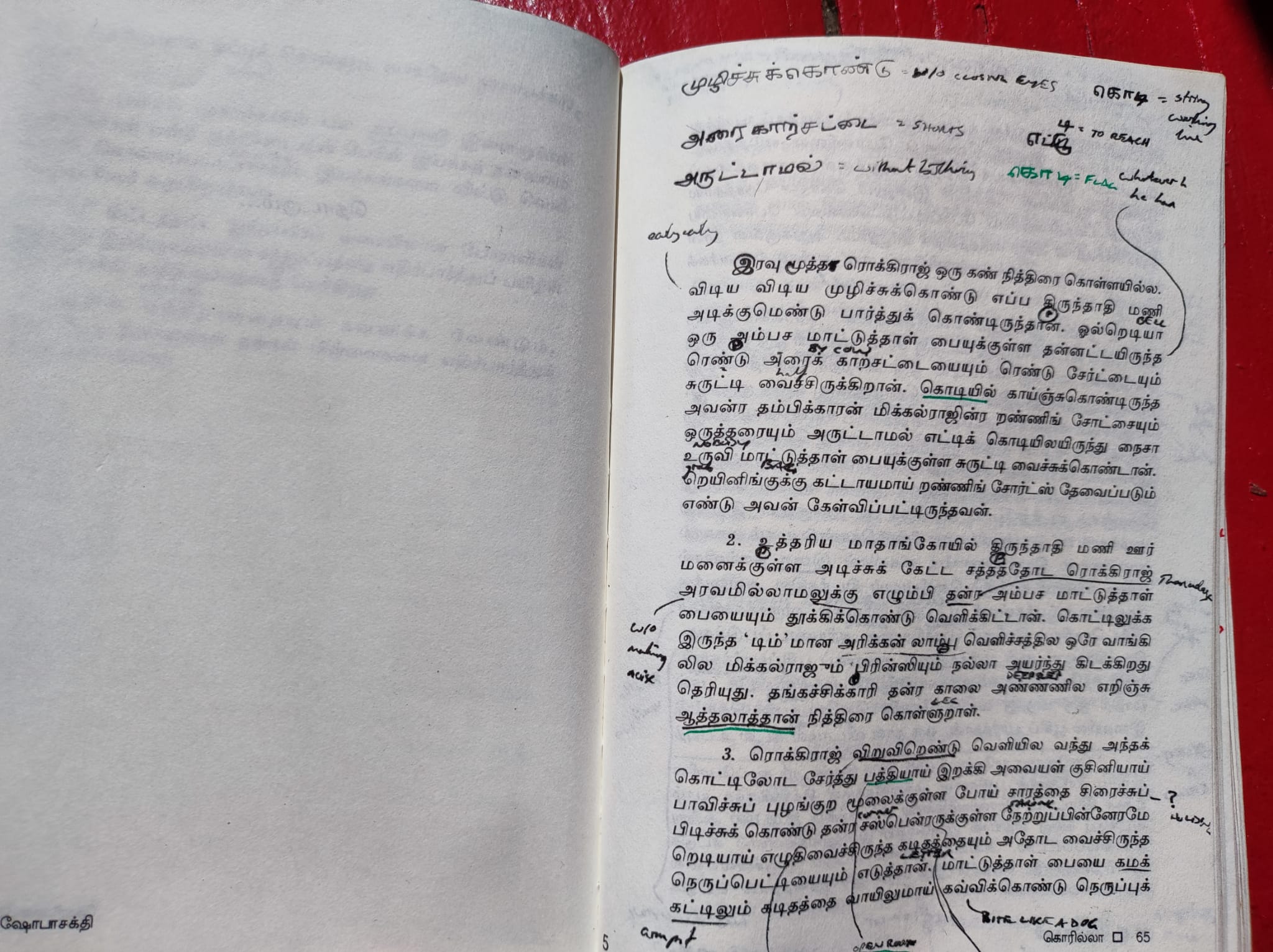
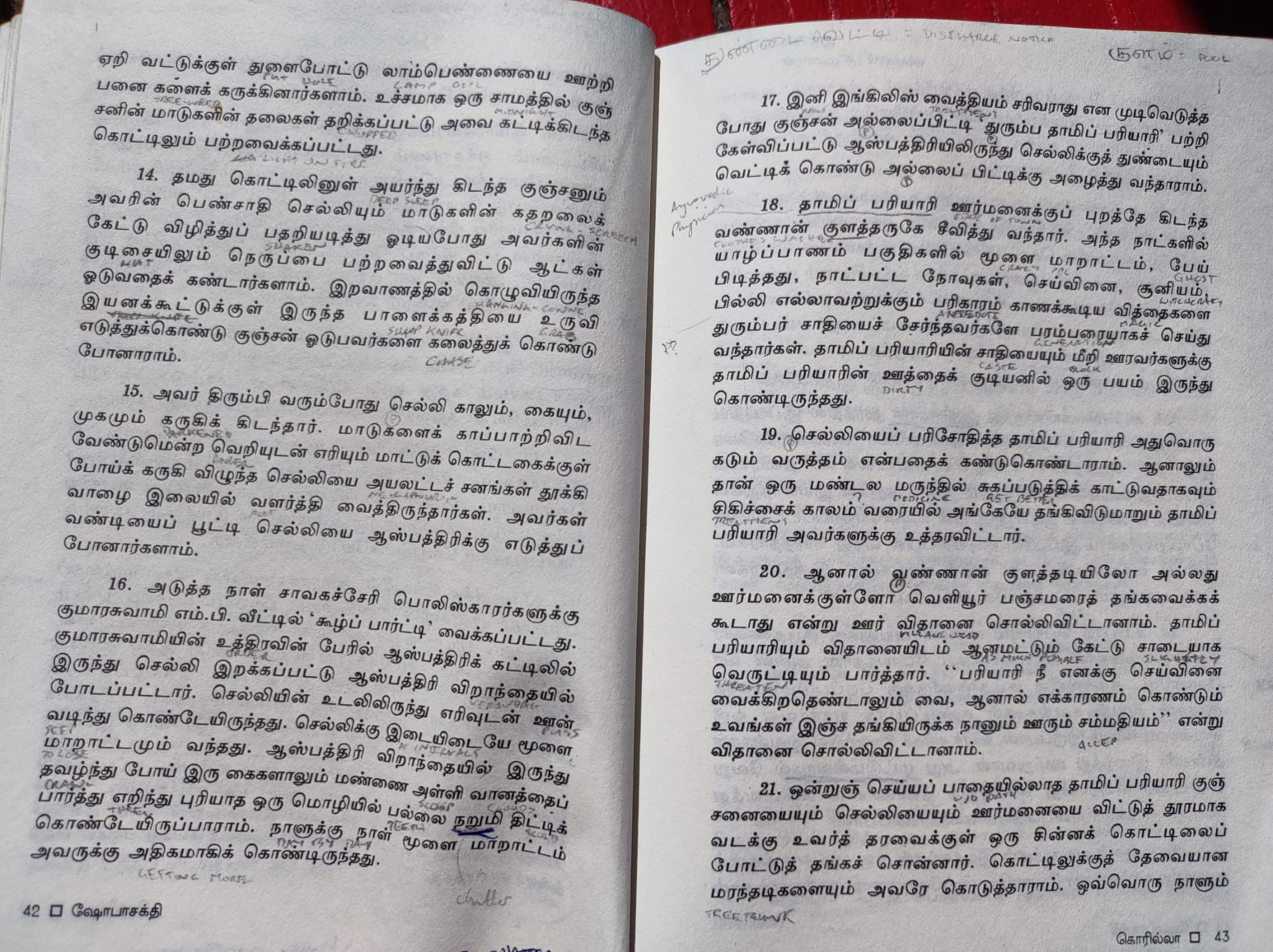
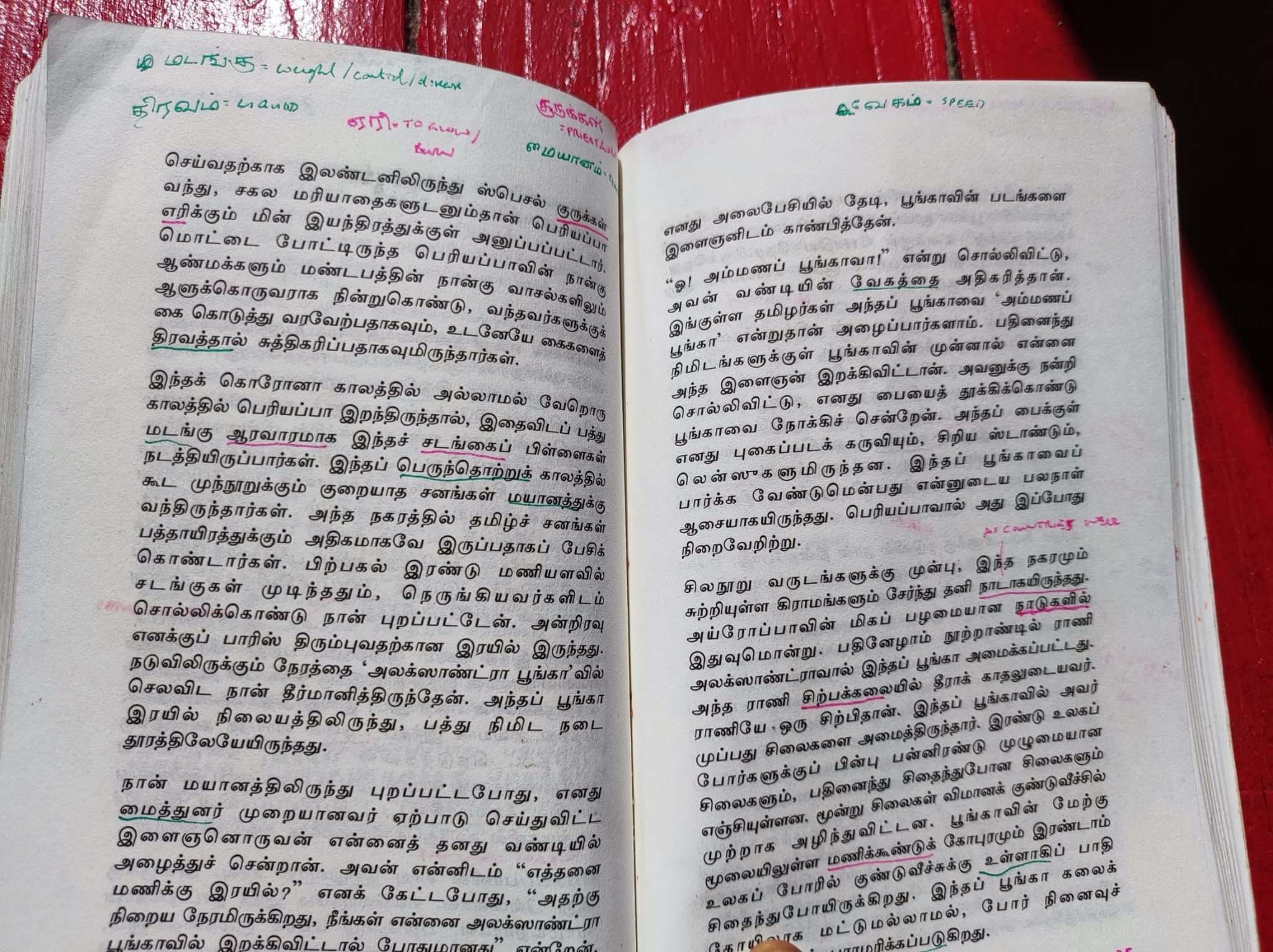
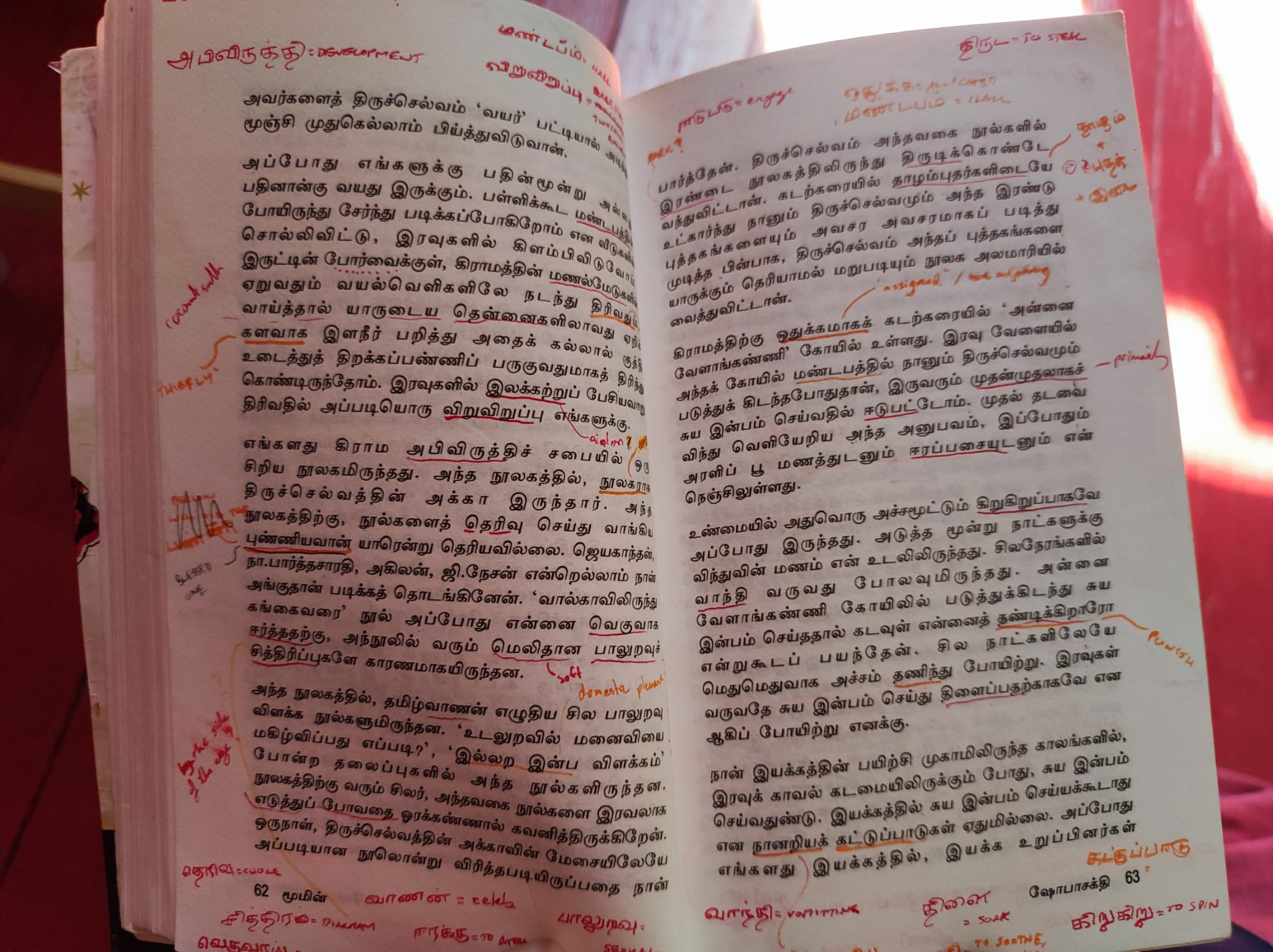
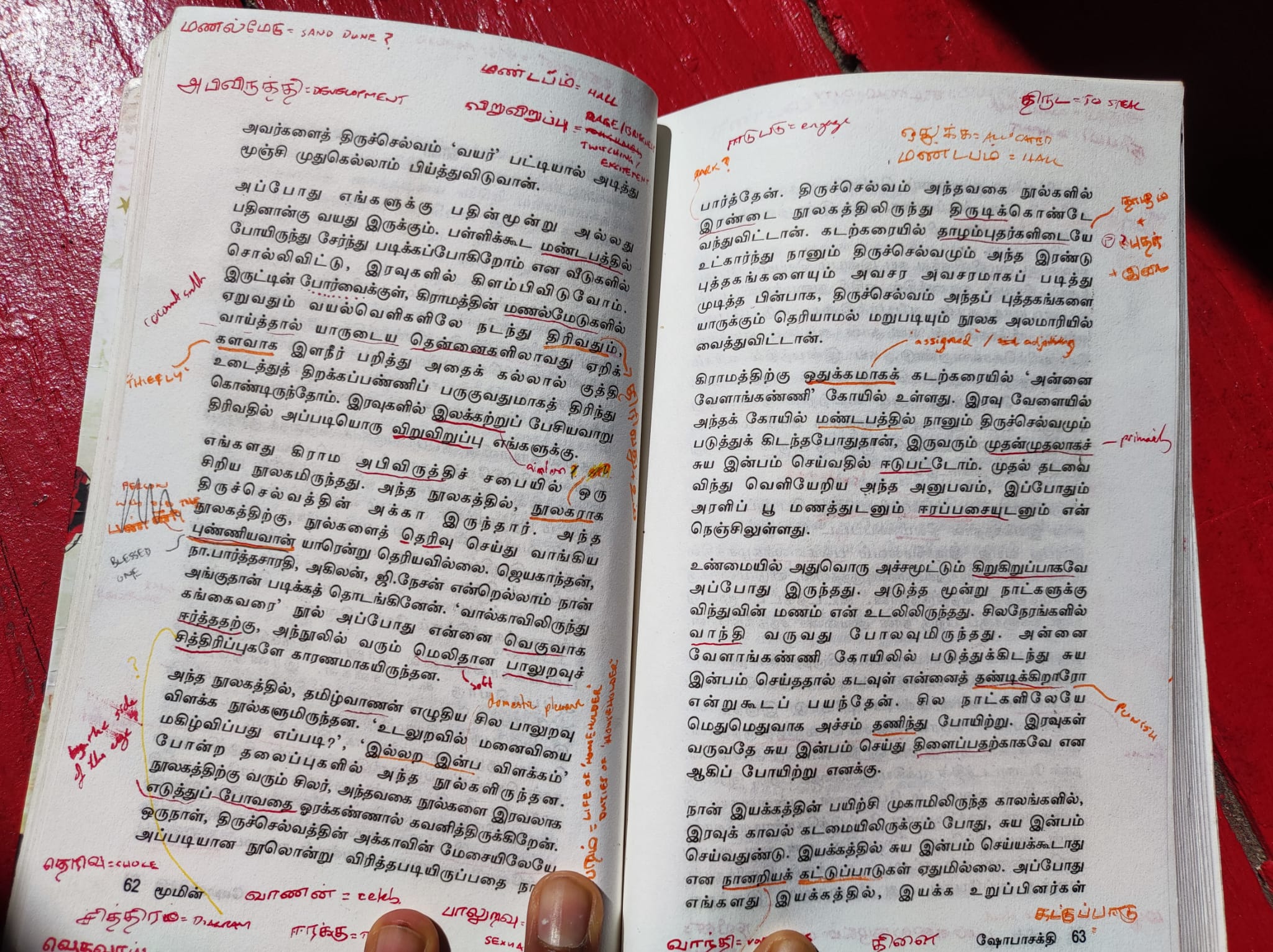
I like to underline the words I don't know and then re-write the word along with its translation in the margins. In a small book, I split the page roughly around the halfway mark and put words from the first half at the top margin and words from the second half in the bottom margin.
For words that I already knew but had to check or for strange constructions which I needed time to de-construct, I draw a line from the word to one of the side margins and write a note there (not re-writing the word in this case)
In the case of Tamil, where I encounter many names, which I do not know are names, I put a small (p) under the name ('name' is peer in Tamil, hence my choice of 'p').
I add these words to a flashcard programme like ANKI and then study them.
I often re-read these chapters without a pen, after I have learned the words.
I then, with no particular rule in regards to time, but rather guided by desire or instinct, return to the book to do a re-read, ideally with a different coloured pen, combing through the words for any unknown words which I had missed and repeating the above process. Depending on your level, it could be repeated several times, as long as it remains somewhat enjoyable.
I actually haven't managed to do this in such a consequential fashion as I am always loosing my pens, but if I could go through my main Tamil-language books again, I would have done this with more structure, because it helps a lot to be able to find the words when reading.
ALTERNATIVE PRACTICE
Once you have done a read and annotation, you can also go through the book, chapter or short story, this time only reading the annotations in the margins, checking if you remember them all and testing yourself on them.
Or you can skim through the text, looking for any underlined words, possibly reading the sentence, and then testing yourself.
EXAMPLES
Early annotations of Shobashakthi’s seminal novel, Gorilla, performed with little attention to aesthetics
More recent annotations of Shobashakthi’s bundle of short stories, Muumin, with attempts to use colour and more differentiation of annotations.
Example 1 | Example 2 | Example 3
* the choice of colour may seem trivial, but it can have a big effect. For example, because my set of preferred pens has dwindled over time, I have sometimes chosen to use a yellow pen. The result is annotations which can be quite hard to read depending on the light, and this can have its upsides, if one wishes to have annotations which aren’t too intrusive.